
In 2005 , at the age of 23, I finally gave into peer pressure and joined Facebook, "only to look at pictures." Now, 4 years later, it is the main mode of communication between many of my friends and me. A lot has changed in those 4 years. For example, I when I joined, Facebook was only for people with college email addresses, and only certain colleges were included. I was slightly troubled when High Schoolers were allowed to join, but utterly dismayed when it was opened up to everybody. Especially when my parents (and in-laws) started to join! Although I am an adult, married, financially independent, and really not very scandalous, there are things on Facebook that I do not need or want my parents (and later my boss) to see. Because of this, I had to use lots of privacy setting on them. Most of the stuff I don't want certain people to see is pictures and comments that other friends post, what danah boyd, in her dissertation, calls "co-constructed"(p. 136) material on my profile. Other things are lived out loud and publicly. As soon as my husband and I got engaged, we rushed home, and "made it official" on Facebook. All of this is to say that although I am not and have never been a teenager on Facebook (or MySpace), I can still easily relate to many teens' situations involving social media and adults.
Social media sites are places to connect (or reconnect) with friends. They are a place to hang out with friends you don't see very often and to continue conversations with friends you see all the time. And to share with both. Like I said earlier, I joined Facebook solely to look at and share pictures with my friends (specifically, pictures of a cruise we had just been on), but soon after joining, I was hooked, refining my profile, and checking others' to see what they were doing. Like boyd's teens, I didn't want to let my profile get stale, because I thought this would leave a bad impression (p. 141). But then, like some of the other teens, I decided too much activity gave the impression that I have no life (whether or not this is actually true), and I stopped updating as much.
I refused (and still refuse) to join MySpace for several reasons, legitimate or not. First, because everyone else was dong it, and I was "too cool" (p.194). Second, (whether this is fair or not) I felt that MySpace was for the less educated (p.202). Third, I felt that Facebook and MySpace serve the same social function, and so once I was on Facebook, I didn't feel the need to join MySpace (p.198). And fourth, I did not want to have to pick my "Top Friends" (p.222), bridesmaids were hard enough!
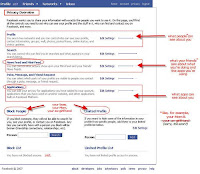
Although my husband and I are technically grown, independent adults, we still have some of the same teen fears and power struggles with our families, and these are reflected in the way we interact with them on Facebook. Both of us have our parents on the "Limited Profile" view on our Facebook accounts. For me, this means that they can't see pictures that friends have tagged me in and they can't see groups that I have joined or certain applications that I have on my profile. Why? Because our parents still feel the need to confront us and reprimand us on lifestyle choices that they don't agree with. For example, about a year ago, my husband (who was 25 at the time) posted a comment on a friend's wall, referencing drinking wine. At the next family gathering, his dad pulled us aside to ask us if we drink from time to time, and to warn us about it. Even in our mid twenties, we still have to worry about our parents (and extended families) "misunderstanding (p.165) " and "not giving us enough credit (p.247)."
So, what makes a twenty something different from a teen, when it comes to social media and the way it effects our lives, and vice versa? Not much, except for actual society and parent's power over them. As much as I hide certain things from my parents and other "adults" in my life, the main motivation is to avoid embarrassment and awkward situations. Teens, on the other hand, have to deal with punishments varying from grounding all the way up the scale. According to boyd, adults seek to restrict teens' actions (both online and offline), because they are afraid of and for them. "Teenagers are alternately viewed by adult society as a nuisance who must be restricted or an impressionable population who mist be protected; they are both deviant and vulnerable (p. 242)." Parents and schools can control whether a teen has easy access to the internet, which parts, and for how long. Both can punish a teen for "private" material posted on social media sites, like the two girls I mentioned last week (p.261). Although many of us may have bosses or workplaces that don't understand or don't subscribe to social media, much less allow it in the work place, were are still free to use it at home. Although we may not have the time or take the opportunity, as adults we are allowed to go out at all hours to hang out with our friends in public places. Not so for teens, who have curfews, anti-loitering laws, and other restrictions placed on when and where they can hang out with their friends. In many cases, social media sites have replaced the mall and parks as the place to hang out with friends for many teens (p.277). So teens live out their private lives in the "public" realm of the internet, knowing that others can look in, but focusing on their friends.
